
How a molecular redesign of toner chemistry turned a midrange laser printer into the industry standard—and why understanding its economics matters more than the spec sheet.
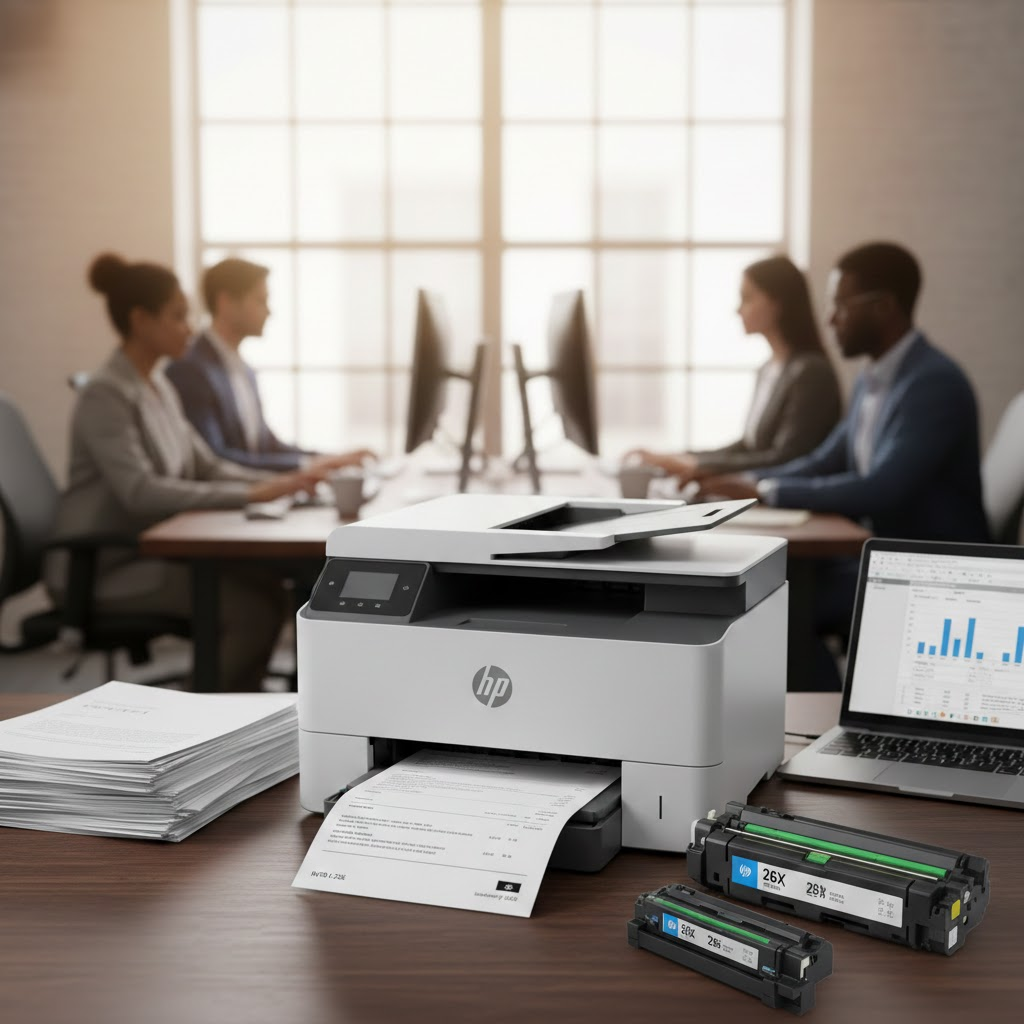
Walk into any medical practice in South Florida, midsize law firm in Manhattan, or regional logistics center in Houston, and you’ll likely encounter the same low, steady hum—the acoustic signature of an HP LaserJet Pro M402 or its multifunction variant, the MFP M426, processing another day’s worth of invoices, contracts, and shipping manifests.
These machines occupy a peculiar position in the office equipment ecosystem: they’re the Toyota Camry of laser printers. Unremarkable in design, relentless in execution, and engineered around a single proposition—minimize downtime, maximize throughput. But beneath the utilitarian enclosure lies a pivotal innovation in laser printing technology: a fundamental rethinking of toner chemistry that shifted the performance ceiling for an entire product category.
This analysis examines how these printers became infrastructure, how businesses can optimize their total cost of ownership, and why the dreaded “10.0000 Supply Memory Error” isn’t necessarily a hardware failure.
The JetIntelligence Inflection Point
Prior to 2015, laser printing technology advanced incrementally—faster processors, larger paper trays, refined imaging algorithms. But HP’s engineers confronted a thermodynamic constraint: conventional toner formulations required high fusing temperatures, which translated to energy-intensive warm-up cycles and thermal management challenges that limited miniaturization.
The solution arrived as JetIntelligence, a platform built around three core innovations:
- ColorSphere 3 toner architecture: HP reformulated toner particles with a crystalline shell encasing a lower-melting-point core, reducing fusing temperature requirements by 15-20 percent. The practical impact: the printer transitions from sleep mode to first-page output faster than most users can walk from their desk to the device.
- Volumetric optimization: The CF226A cartridge family introduced a more compact internal architecture, creating headroom for increased toner capacity without expanding the cartridge footprint—a nontrivial engineering achievement in injection-molded plastics.
- Supply chain authentication: This generation also marked HP’s deployment of sophisticated chip-based cartridge verification, ostensibly to ensure quality but with significant implications for third-party consumables markets.
Market Position and Use Case
The M402/M426 series wasn’t designed for occasional home use. These are small-to-midsize business workhorses.
| Specification | HP LaserJet Pro M402dn / M426fdw |
| Optimal monthly volume | 750–4,000 pages |
| Primary verticals | Healthcare, legal services, logistics, accounting |
| Common document types | Invoices, bills of lading, contracts, medical records |
| Key differentiator | 38 ppm output with automatic duplex |
For organizations where printer availability directly correlates to revenue—medical billing departments, law offices processing discovery documents, and warehouses managing inventory—these devices remain compelling options in both refurbished and secondary markets, even a decade after their introduction.
Total Cost of Ownership: Beyond Sticker Price
Purchasing managers often fixate on cartridge retail prices while ignoring total cost of ownership. A more rigorous analysis reveals different optimization strategies.
HP offers two cartridge variants:
- CF226A (standard yield): ~3,100 pages
- CF226X (high yield): ~9,000 pages
The high-yield option reduces cost per page by approximately 30 percent through simple volumetric efficiency. But the more significant variable is cartridge sourcing strategy.
OEM vs. Remanufactured Economics
Modern remanufacturing has matured considerably. High-quality remanufactured cartridges use OEM shells that pass defect screening, with all wear components—organic photoconductor drums, wiper blades, and magnetic developer rollers—replaced and refilled with toner that meets or exceeds OEM specifications.
Comparative analysis (50,000-page volume):
| Cartridge type | Unit cost | Cost per page | Total cost | Savings vs. OEM |
| OEM HP 26X | ~$230 | ~$0.025 | $1,250 | — |
| Premium Reman. 26X | ~$75 | ~$0.008 | $400 | $850 |
Note: Pricing represents market averages; actual costs vary by vendor and volume commitments.
Troubleshooting: The 10.0000 Supply Memory Error
Even well-engineered systems exhibit failure modes. For the M402/M426 series, the most frequent support issue involves cartridge communication failures.
Error code: “10.0000 Supply Memory Error”
- Symptoms: The printer display shows an error message preventing job execution, or the orange attention indicator blinks continuously.
- Root cause: Communication failure between printer controller and cartridge memory chip, typically triggered by contact contamination, chip misalignment, or firmware that rejects third-party authentication signatures.
Resolution protocol:
- Verify physical installation: Remove the cartridge and confirm all shipping locks and protective tape have been completely removed.
- Clean electrical contacts:
- Locate the gold-plated chip array on the cartridge’s lateral surface.
- Gently clean with a lint-free cloth moistened with isopropyl alcohol (>90% concentration).
- Inspect corresponding spring contacts inside the printer cavity for debris or deformation.
- Power cycle reset:
- Power on the printer.
- Disconnect AC power (do not use the front panel power button).
- Wait 60 seconds to discharge capacitors.
- Reconnect power.
- Bypass mode: For non-OEM cartridges, most M402/M426 units allow override by pressing “OK” or “Continue.” The printer will function normally but disable toner level reporting.
Conclusion
The HP LaserJet Pro M402/M426 series represents mature industrial design: unspectacular but optimized for reliability and operational efficiency. These printers succeed not through innovation theater but through disciplined engineering—refined thermal management, improved toner chemistry, and component durability that translates to lower total cost of ownership.
The machines that power the back offices of American commerce rarely make headlines. But they shape the economics of countless businesses—one perfectly rendered invoice at a time.